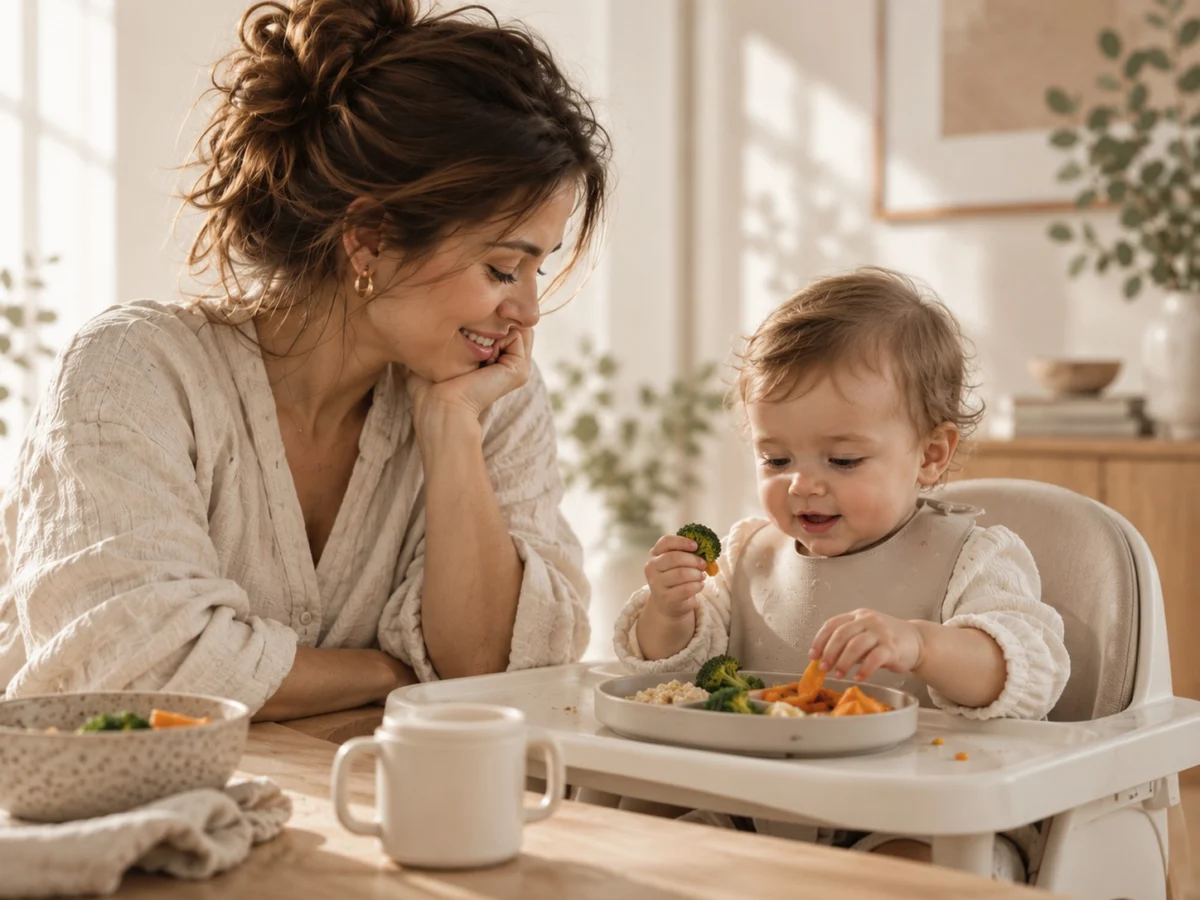
Baby-led feeding can quickly become another parenting identity with rules to get right: which foods count, how food should be offered, whether helping is allowed and whether using a spoon means you have failed the method. That level of policing can obscure the part many families actually find useful.
Mealtime autonomy is not about leaving a baby to manage food alone. It is about creating age-appropriate ways for a child to participate while adults continue to provide the structure of family meals. You can support exploration and independence without making every plate a test of the method.
Separate adult responsibilities from the child’s room to participate
Adults still organize the meal: what food is available, when eating opportunities happen, where the child sits and what boundaries keep the table workable. Within that structure, the child can have meaningful agency—what they touch first, whether they want more of something offered, when they seem finished and how they gradually handle cups or utensils.
Autonomy is not the same as total independence. A baby may grasp food while you steady a bowl, bring a preloaded spoon to their mouth or drink with help. Later, a toddler might carry a napkin, scoop a small portion or help place something on the table. Participation grows in layers.
Some days a child wants to do everything alone; other days they want more help. Assistance does not cancel autonomy. The question is whether the child still has a role in the meal rather than whether they performed every step without an adult.
Keep one plate from becoming a report card
It is easy to inspect the tray after every meal: Did they eat enough? Try enough variety? Throw too much? Eat as much as another baby you saw online? When every plate has to prove progress, pressure returns to the table even if the original goal was relaxed feeding.
A single meal can include tasting, touching, rejecting, repeating a familiar food or showing very little interest. It does not need to summarize the child’s entire relationship with food. Social media comparisons are especially poor evidence because you see one photographed plate, not the week around it or the interaction at the table.
Reduce commentary when it starts to feel like performance. “One more bite,” “Look, you like it,” and enthusiastic praise can all keep attention fixed on how much the child eats. Eat your own food, talk about family life and allow quiet stretches. A low-pressure meal can still include guidance without every bite becoming an event.
Allow exploration while keeping boundaries that make meals livable
Food exploration is messy, but low pressure does not mean the adult has no limits. You can allow touching, squishing and learning while stopping repeated plate throwing: “You can explore the food. I won’t let you throw the dish. If you are finished, I’ll move it.” The child’s disappointment about that boundary does not make the table controlling.
Family meals also do not require an entirely separate menu every time a child refuses something. Many households serve components that people can combine differently, perhaps with something familiar alongside less familiar foods. Flexibility can come from presentation rather than running a second restaurant.
Likewise, the equipment is not the philosophy. Suction plates, special utensils and trendy accessories can be useful if they solve a real problem, but they do not create autonomy by themselves. A stable place at the table and simple tools your family can manage may be enough.
Use baby-led feeding as a principle, not an all-or-nothing badge
Real families often mix approaches. Finger foods can coexist with spoon-feeding. A child can self-feed part of a meal and receive more help at another. The deeper consistency can be the atmosphere: adult structure, gradual participation, fewer power struggles and room for the child to learn by doing.
A “calm” meal does not mean a spotless floor or a child who eats everything cheerfully. There can be refusal, mess, limits and chaotic evenings. Calm means the adult does not have to chase bites, bargain constantly or define success by the amount consumed in that single sitting.
Think beyond today’s tray. Over time, children can take on more of family mealtime: carrying utensils, serving small portions, asking for more, noticing routines and helping with simple preparation. That gradual participation matters more than whether every meal qualifies under a strict method label.
Parents may also notice that their own anxiety rises when a child eats differently from one day to the next. Returning attention to the repeated family structure—rather than trying to correct every meal in real time—can make it easier to respond consistently without turning uncertainty into pressure.
If baby-led feeding helps your family create space for participation and less pressure, use those ideas. If the label turns meals into another performance to perfect, return to the simpler foundation: adult structure, shared food and room for the child to learn through real participation.