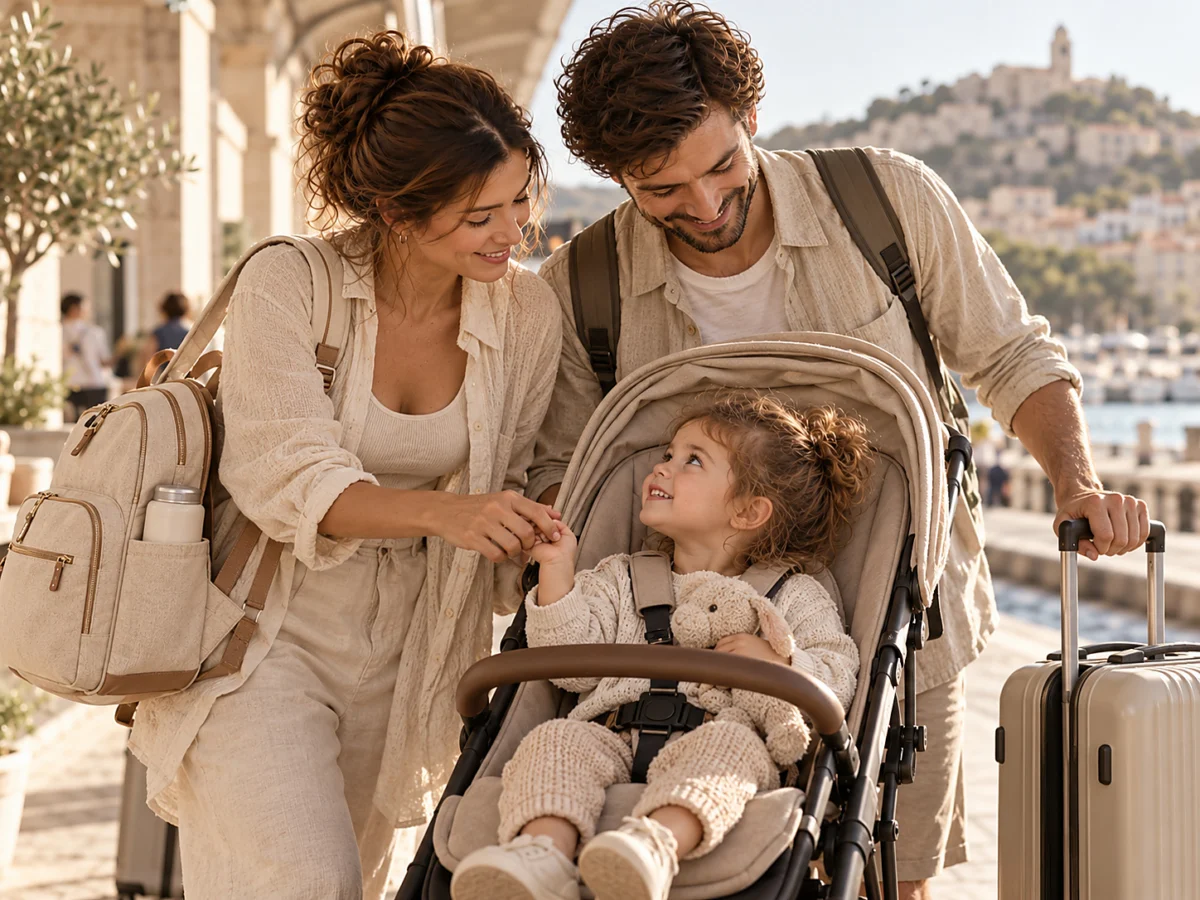
A flight with a baby starts long before you sit down on the plane. It starts while folding a stroller with one hand, finding documents with the other, or realizing the baby has a spare outfit but the adult covered in spit-up does not.
Useful preparation is not predicting every possible problem. It is making the likely problems easy to solve while one of your hands is already occupied and there is very little room to improvise. The goal is not to carry a portable version of your house. It is to reduce the number of steps between “we need something” and “we have it.”
Pack by moments of use, not only by category
Your carry-on needs to work as a quick-access system. Items you may need at any point—diapers, wipes, a complete baby outfit, a bag for wet or dirty clothes, the feeding supplies your baby normally uses, any routine medication, and one familiar comfort item—should come out without unpacking everything. A small diaper-change pouch can keep you from taking the entire bag into a tiny airplane restroom.
Think in zones: diapering, feeding, sleep, and adult. The adult zone matters too. A lightweight spare shirt, an empty zip bag, or another small practical item can save a long stretch of the trip. Things you will not need until the destination do not deserve the best access space.
Before closing the bag, run a one-handed test. Imagine the baby is crying and you can only use one hand. Can you find a diaper, wipes, and a change of clothes without emptying the bag? If not, the problem may not be what you packed but how it is arranged.
Think of the airport as a chain of transitions
A stroller, baby carrier, or combination can work differently depending on the baby, airport, and amount of luggage. Picture each transition: terminal entrance, security, the gate, possible bus boarding, storing carry-ons, getting off the plane, and baggage claim. Something convenient for one part of the airport may be awkward in another.
Check the airline’s current rules for strollers, infant baggage, seating, documents, and gate-checking because policies vary by carrier and route. It is not worth building your whole plan around a rule you remember from a different airline or a previous year.
If two adults are traveling, assigned jobs are often calmer than both trying to help with everything. One person can own documents and luggage during high-movement transitions while the other is primarily responsible for the baby. You can switch later. “We’re both handling everything” is how passports end up in the wrong pocket.
Plan to feed, change, and soothe without depending on a perfect schedule
Your baby may want to eat when boarding begins or need a diaper change after everyone is seated. Bring the feeding setup your baby already knows instead of introducing a complicated travel system. If bottle-feeding, think through how supplies will be stored and accessed under current travel rules. If breastfeeding, consider what will make the airport and seat feel manageable for you.
Sleep will probably bend too. A baby may nap on the way to the gate and wake at takeoff, or stay awake through the nap you hoped would cover half the flight. Keep familiar cues—contact, pacifier if used, a familiar song, a lightweight comfort item, or a known holding position—but treat the clock as flexible.
For a few hours, responding to the baby in front of you is usually more sustainable than preserving every home interval. One unusual day does not undo a household routine. Trying to maintain every nap and feed at the exact normal time can create more stress than the flight itself.
Make the seat work with as few loose things as possible
Once you are on the plane, the less you need to unpack and repack, the easier the space is to manage. Keep a small set of essentials accessible and leave the rest closed. If you pull out five toys, three blankets, and every pouch before takeoff, you will have to manage all of them when space becomes even tighter.
Entertainment does not need to be constant or entirely new. Babies may spend time watching the environment, touching a familiar object, feeding, sleeping, or interacting with you. They may also cry, squirm, or need movement. Your job is to care for your baby reasonably in a shared space, not to guarantee silence for everyone on the aircraft.
When something goes wrong—a leak, delay, missed nap, or baby who will not settle—come back to the next concrete need. Change, feed, hold, walk when possible. Thinking about the entire remaining trip at once can make one difficult hour feel like the failure of the whole journey.
Leave a little recovery room after landing
Landing is not the end of the logistics. There may still be bags, stroller pickup, ground transportation, hungry adults, and a baby who just woke up. If you can, avoid scheduling an important activity immediately. Even a short pause to change the baby, eat something, and reorganize bags can keep the flight chaos from following you for the rest of the day.
After the trip, notice what you actually used and what was hard to reach. That information is more valuable for your next flight than a generic packing list. You may discover you brought too many clothes, needed a better small pouch, or found the carrier useful only during one specific part of the airport.
Good logistics will not make flying with a baby feel exactly like flying without one. They simply remove steps, searching, and unnecessary decisions between a need appearing and you being able to meet it.