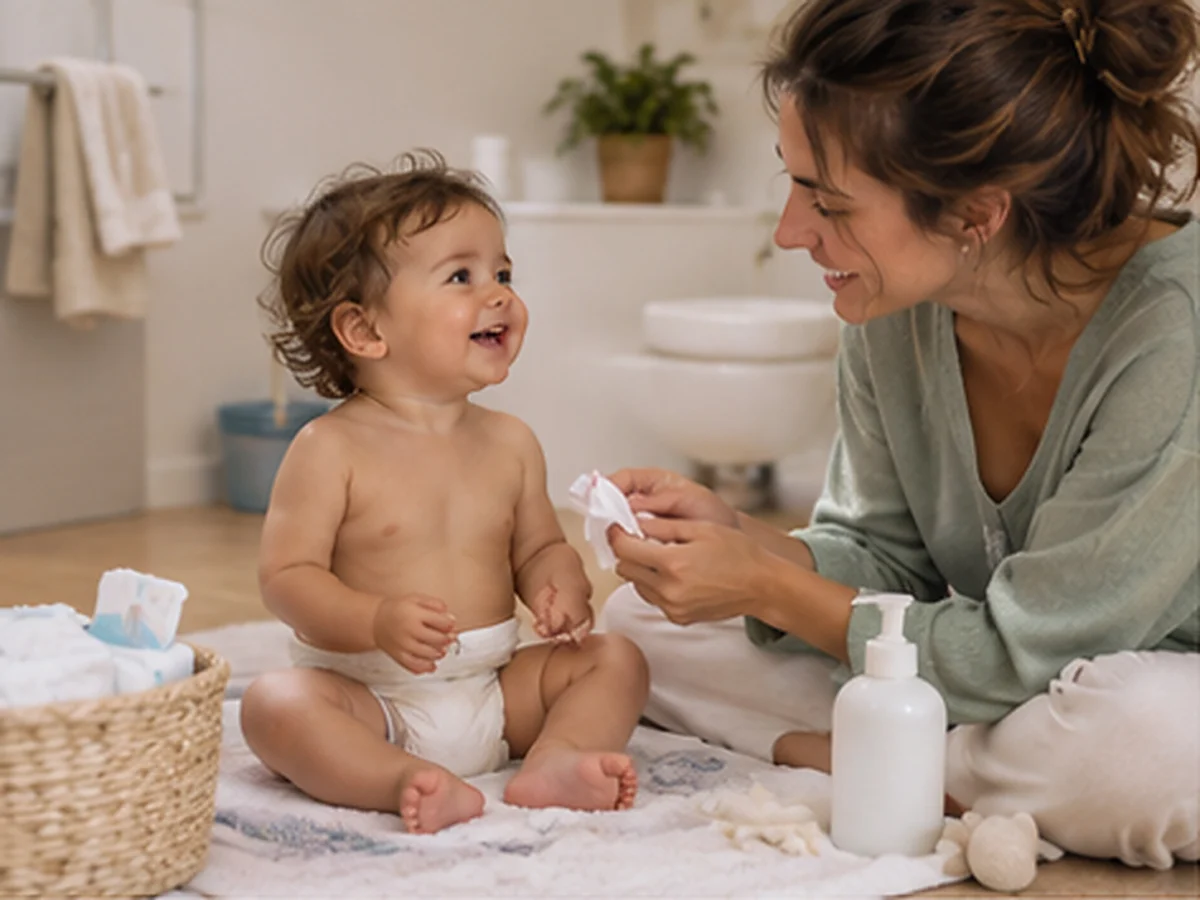
Potty training can go from a normal family transition to a full household project very quickly.
You pick a weekend. You buy underwear. Someone recommends a sticker chart. Someone else says you should take away diapers completely. Suddenly you are asking “Do you have to pee?” every fifteen minutes and measuring the day by how many pairs of pants are still dry.
There is another way to frame the process. Learning to use the toilet can be treated like many other independence skills: prepare the environment, explain what is changing, offer opportunities to practice, help when needed and respond to mistakes without turning them into a moral event.
A respectful approach does not mean the child is in charge of every decision or that you wait forever for a dramatic announcement that they are done with diapers. Parents still create the structure.
The difference is the tone: less pressure to perform, more room to learn.
Start with your child and your actual family life
There is no single date when every child must start potty training.
Instead of chasing the perfect age, look at the practical picture. Is your child interested in what happens in the bathroom? Can they participate in pulling clothing up and down? Do they sometimes communicate that they need a change or want to try the potty? Are they willing to sit briefly without the whole situation becoming a fight?
Family timing matters too. If you are moving, traveling, welcoming a sibling or starting a new childcare arrangement, adding another major transition may be harder to support calmly.
That does not mean potty training is forbidden during a busy season. It simply means you should ask whether the adults have enough bandwidth for accidents, extra laundry and a learning curve without becoming angry.
The best time is not necessarily the most perfect one. It is a time when practice can fit into family life without taking over everything.
Make the bathroom easier to use
Independence gets easier when the environment does some of the work. A reachable potty or stable toilet setup, clothing that is easy to push down, a step stool where appropriate and spare clothes nearby can reduce the number of times a child needs an adult for every small step.
You do not need a bathroom full of special products. Think about the sequence your child is learning: get there, manage clothing, sit, ask for help, get dressed again and wash hands as part of your family routine.
At first, the adult may do most of it. The goal is not immediate independence. It is giving the child more opportunities to participate over time.
You can keep the language simple. “We’ve been using diapers. We’re going to start practicing using the potty during the day.” You do not have to promise that it will be fun or present underwear as a prize a child earns by being successful.
Neutral language matters because it makes accidents less loaded too. If this is practice, an accident is not proof that the child failed. It is part of learning a new routine.
Do you need to ask every twenty minutes?
It is tempting. Once the diaper comes off, every wiggle can look like a sign. Parents ask before leaving, before getting in the car, after arriving, before lunch, after lunch and every few minutes in between.
Constant prompting can make the entire day revolve around the toilet. Instead, use a few predictable transition points: after waking, before leaving the house, before a long car ride or at another point that naturally fits your routine.
If going before you leave is not truly optional, it can also be clearer to say “Let’s stop at the bathroom before we go” rather than asking “Do you want to pee?” and then arguing with the no.
What if your child refuses to sit?
Try not to turn the potty into a place where physical battles happen. If every attempt includes chasing, repeated demands and escalating frustration, resistance may start to become the main story.
You can offer a clear invitation, allow some refusals when the situation allows, and keep a few routine opportunities predictable. If resistance is intense and constant, lowering the pressure for a while may be more useful than doubling down.
Taking a break is not automatically failure. Sometimes it is a decision to prevent the whole process from becoming a power struggle.
Accidents do not need an interrogation
Accidents can be frustrating, especially the fourth one of the day. Still, “I told you to go,” “Why didn’t you tell me?” or “You’re too big for this” cannot teach the body to notice sooner. They can teach embarrassment.
A neutral response is enough: “Your pants are wet. Let’s get changed.” If your child is able, invite them to participate—carry the wet clothes to the hamper, choose the clean pair or help with a simple part of cleanup.
Not as punishment. Just as the ordinary consequence of what happened. The accident already has a natural inconvenience: everyone pauses and changes clothes. It does not need an added penalty.
Stickers and candy are popular because they make progress visible and can create quick enthusiasm. They can also turn toileting into a transaction.
The conversation becomes, “What do I get if I pee?” If you prefer not to build that system, you can notice progress without paying for it.
“You remembered to go.” “You pulled your pants down by yourself.” “You stopped playing because you noticed you needed the potty.” You can smile and be genuinely excited. The difference is that the bathroom does not need to produce a prize every time.
Home can feel manageable. Then you need groceries. Keep a spare outfit easy to reach. Know where a restroom is when that is practical. Choose clothes that are not complicated to remove.
Before a long drive, a bathroom stop can simply be part of leaving the house. Try not to treat the outing as a test of whether your child is “really trained.”
There may be an accident at the playground. You may head home earlier than planned. For a while, bathrooms may occupy far more of your mental space than usual.
That is part of the transition, not proof it is going badly.
Daycare, preschool, grandparents and other caregivers
When several adults share care, agree on a few basic ideas. Everyone does not need identical language, but it helps if the child is not moving between completely opposite systems—calm accidents in one place and shame or huge rewards in another.
Share what clothing makes independence easier, how you are approaching reminders and how you prefer accidents to be handled. Also listen to the realities of the setting. A preschool classroom with multiple children may have bathroom routines that are different from home.
The goal is not to micromanage caregivers. It is to keep the child from becoming the messenger between adults who never coordinated.
What if your child asks for a diaper again?
It can happen. Maybe the day is exhausting. Maybe you are away from home. Maybe the novelty of underwear disappeared.
Before treating the request as a battle of wills, look at the overall process. Has the bathroom become the topic of every conversation? Are reminders constant? Are you fighting about it every day? Do you need a short pause, or is this simply one hard moment?
If you decide to pause, avoid framing it as punishment: “You had accidents, so you’re back in diapers.” You can say, “We’re going to take a break from practicing and try again later.”
That protects the idea that toileting is a skill still being learned, not a test the child failed.
The moment potty training begins, informal statistics appear. A cousin did it in a weekend. A friend’s child never had accidents. An older sibling was younger. An influencer has a method that supposedly works in three days.
Those comparisons create urgency without giving you much useful information. “Potty trained in three days” can also mean many different things—from staying dry at home for one afternoon to managing bathrooms independently in multiple places.
Skills do not have one single finish line.
The goal is growing independence, not a performance
Potty training gets lighter when it stops being something your child has to accomplish to make adults proud. You prepare, guide and make family decisions. Your child practices a new relationship with clothing, the bathroom and their own routines.
There will be dry days and wet clothes. Easy outings and inconvenient ones. Moments that look like a leap forward and days that look like a step back.
You do not need to turn every success into a party or every accident into a conversation.
If your child can practice without shame, the bathroom is not becoming a daily power struggle, and independence is slowly growing, meaningful learning is happening even if you still keep spare pants in the bag.