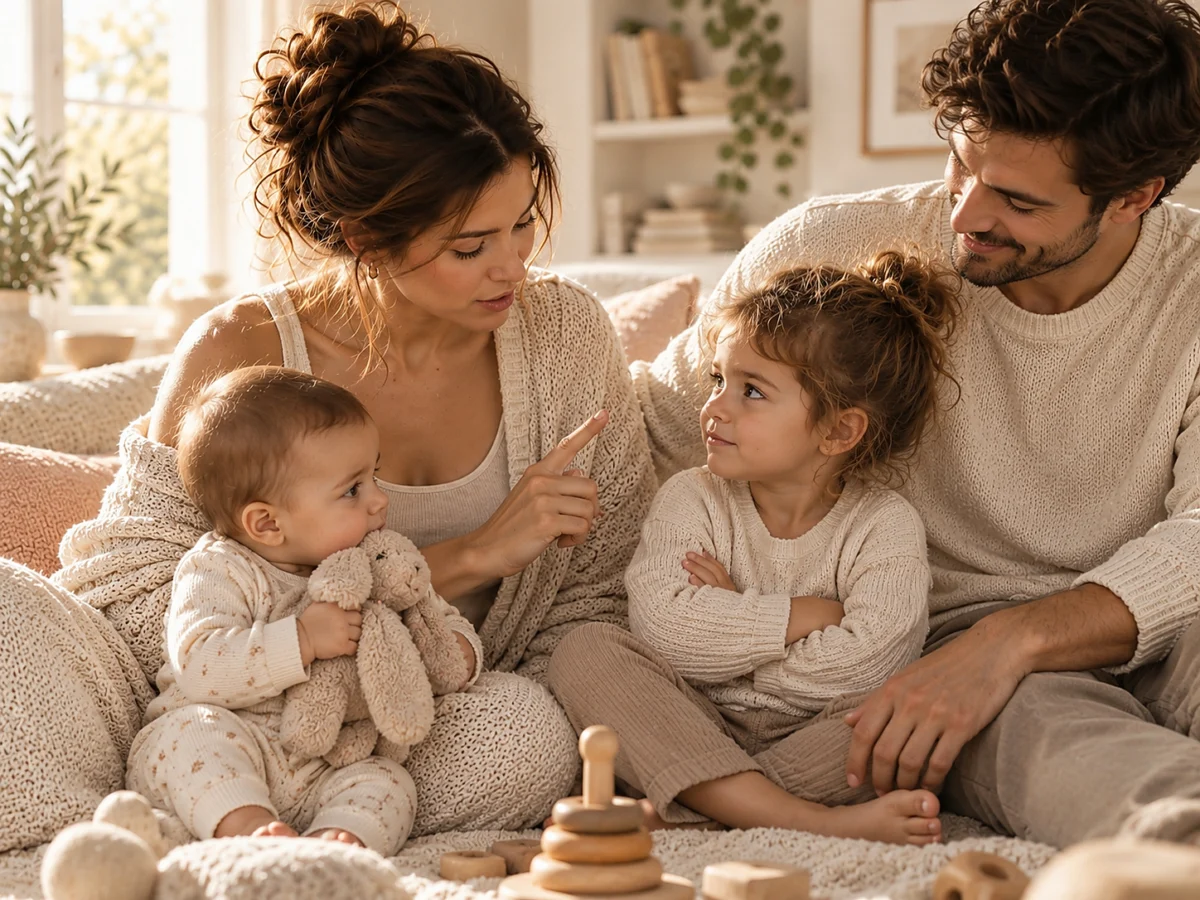
“She took it.” “He started it.” “Tell him to stop.” In a home with siblings, a parent can become the appeals court for dozens of tiny disputes every day without meaning to.
Making a ruling is tempting because it creates fast closure. You decide who had the toy first, who gets the seat, whose turn it is, and for a few seconds the room gets quieter. But if every disagreement ends with an adult verdict, children get less practice noticing the problem, expressing what they need, and finding a workable next step.
The goal is not to leave siblings alone with every conflict. It is to know when you are protecting safety, when you are coaching, and when you are unnecessarily deciding the winner.
Step in firmly for harm, but not every disagreement needs a courtroom
If there is hitting, biting, dangerous behavior, intimidation, or one child is clearly overwhelmed, intervene. “I won’t let you hurt each other. I’m staying here.” Safety does not require an investigation first.
Many conflicts, though, are lower stakes: two children want the same object, one wants to keep playing while the other wants space, or both insist they had an idea first. In those moments, pausing before solving can be useful.
Parents often ask, “Who started it?” as if the answer will make the solution obvious. But sibling conflict usually has a history. One child grabbed because the other had been teasing; the teasing started because someone was excluded earlier; the exclusion followed yesterday’s argument. Reconstructing the whole chain can turn both children into lawyers defending their case.
A more useful question is often, “What is the problem right now?” That moves the family from blame toward the next step.
Describe what you see before deciding what should happen
“You both want the same truck.” “You wanted your building left alone, and your sister wanted to join.” “You thought the game was still going; he was finished.” Description lowers the amount of interpretation and gives children a clearer problem to respond to.
This is not the same as being neutral about harm. You can stop a shove immediately without deciding that one child is “the difficult one.” Labels such as “she’s always the instigator,” “he’s the sensitive one,” or “you know your brother is little” make adult decision-making faster, but they can harden family roles.
The responsible child may be expected to give in because they “know better.” The younger child may get fewer chances to learn boundaries. The child seen as aggressive may enter every conflict already presumed guilty.
Talk about this incident rather than assigning a permanent identity.
Coach skills without taking over the outcome
Children often need language before they need a solution. “You can say, ‘Don’t touch my tower.’” “Ask when you can have a turn.” “Tell her you want to play alone right now.” Lending words is different from deciding whose preference wins.
The same applies to fairness. Sibling arguments frequently pull parents toward mathematical equality: same number, same minutes, same portion, same privilege. But family fairness is often about needs and context rather than identical treatment.
You can say, “I try to make sure both of you are cared for. That doesn’t always mean the exact same thing at the exact same time.” An older child does not automatically owe a younger sibling their toy because they are more mature. A younger child does not automatically get first access because waiting is harder for them.
Protecting both children’s dignity may mean helping one wait while allowing the other to finish, creating separate spaces for special projects, or ending an activity when neither child can use it safely.
Sometimes the best coaching happens later. If everyone has moved on, you may not need a ten-minute debrief. But if a pattern keeps returning, a calm conversation can help: “It seems mornings are when you both want the same space. What could we set up differently?”
A healthy sibling relationship is not a conflict-free relationship
Siblings share parents, space, objects, routines, family history, and years of close proximity. Friction is not evidence that the relationship is failing. They can love each other and still need privacy. They can enjoy playing together and still fight intensely. They can go through seasons of closeness and seasons when they irritate each other constantly.
Pressure to perform affection can make conflict harder. “You’re siblings, you have to play together,” “give your sister a hug,” or “he’s your best friend” may ignore the need for boundaries and individual space.
Your job is less about manufacturing harmony and more about protecting safety, preventing rigid roles, and giving children enough language and structure that small disagreements do not always require a judge.
You do not need to decide who wins every fight. Over time, the better measure is whether your children are learning how to disagree without losing their own dignity or erasing the other person’s.