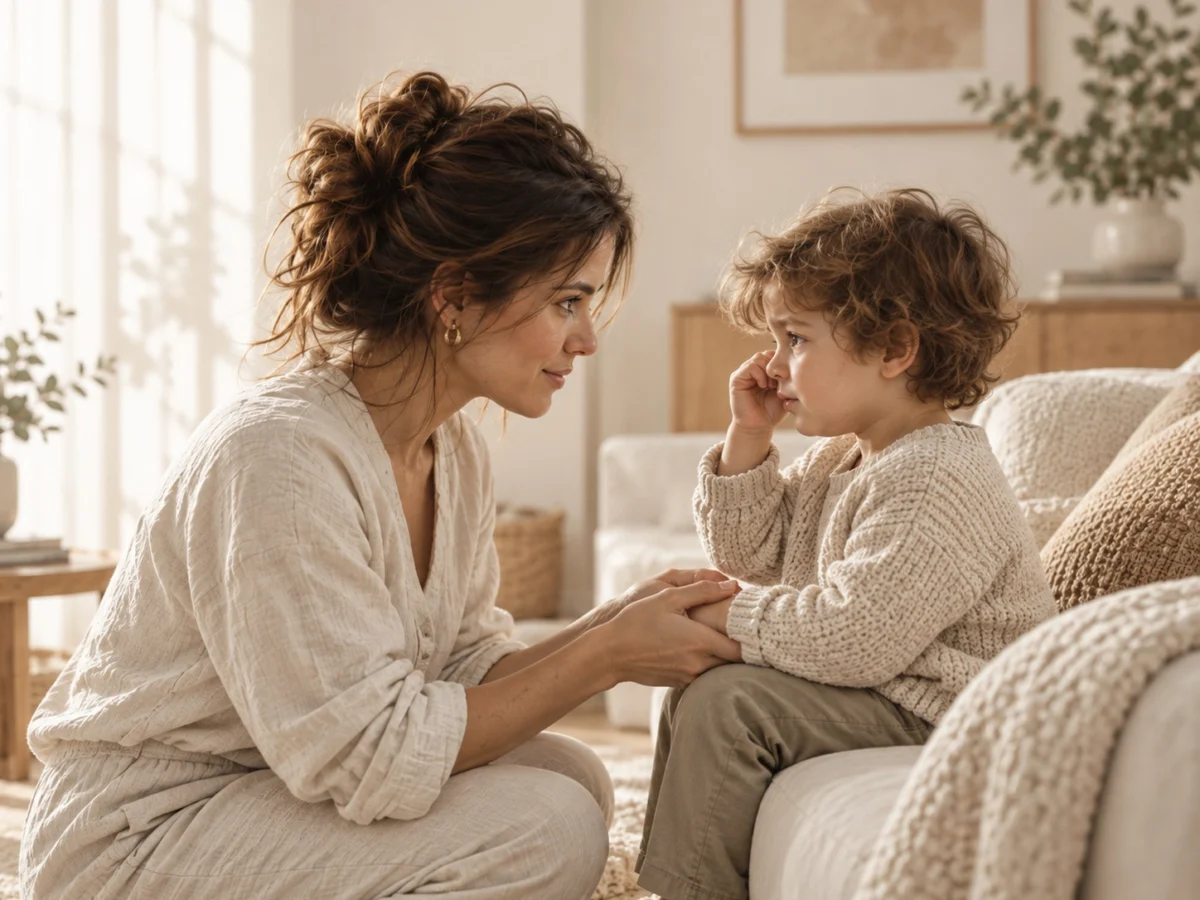
Before the baby, you are already many things at once: friend, partner, professional, daughter, sibling, person who needs solitude, person with interests, habits and a particular way of working, resting and spending time. Pregnancy can bring the fear that all of that complexity will soon be compressed into a single word: mother.
Becoming a mother can transform identity without erasing the person who existed before. The task is not choosing between keeping yourself and becoming a parent, but integrating a new role without requiring every other part to disappear or stay exactly the same.
Name the specific parts of yourself you are afraid of losing
“Losing my identity” sounds total, but it often contains more specific concerns: work, creativity, friendships, alone time, physical autonomy, financial independence, interests, humor or the experience of making decisions without considering someone else’s needs first.
Naming the pieces helps separate them. Some may have less room during an intense caregiving season. Others can be protected through support and planning. Some may change form, and some may turn out to matter differently than you expected.
This also keeps every practical change from becoming evidence of disappearance. Reading less for a few months does not mean you are no longer a reader. Pausing a work project does not automatically erase a professional identity.
Do not make “getting back to my old self” the only proof that you still exist
After a major transition, people often talk about getting themselves back. That idea can be comforting, but it can also become rigid if it assumes the only acceptable version of you is the exact person who existed before the baby.
Some parts may return almost unchanged. Others may need a different shape. New priorities, interests and boundaries may emerge too. Continuity does not require staying still; you can recognize yourself in a life with a different distribution of time and responsibility.
Instead of asking, “Will I be the same?” try, “What do I want to keep recognizing as mine even if its form changes?” That question leaves room for development without declaring your previous self lost.
Protect actual spaces where you are not only the person providing care
Identity needs more than theoretical permission. If you are always the person who is available, plans, notices and remembers, it becomes difficult for interests and adult relationships to have real space. Small forms of protected time can therefore matter: continuing part of your work, a creative practice, a friendship or simply conversations where parenting is not the subject.
This does not need to become an elaborate self-care project. It may be a few pages of a book, a solo walk, a regular class, a conversation about politics or movies, or an hour in which another caregiver is fully responsible. What matters is that these pieces do not depend entirely on leftover time.
It can also help to ask people around you to keep asking about you, not only about the pregnancy and later the baby.
Talk about identity before personal time is treated like a luxury
If you have a partner or support network, pregnancy is a useful time to discuss how one person will be protected from becoming the permanent default caregiver. Will there be periods when you are not responsible? Will other caregivers learn routines without needing you to supervise? Which parts of your life would you especially like to keep present?
You cannot promise everything will receive the same amount of time. You can avoid beginning with the assumption that your interests are optional while other adults’ time stays intact.
If after birth you feel intensely or persistently as though you have disappeared, or that feeling is part of broader distress that concerns you, talk with trusted people and consider professional support.
You do not have to choose between preserving yourself and becoming a mother. Motherhood can change you without becoming the only story, relationship or word available to describe who you are.