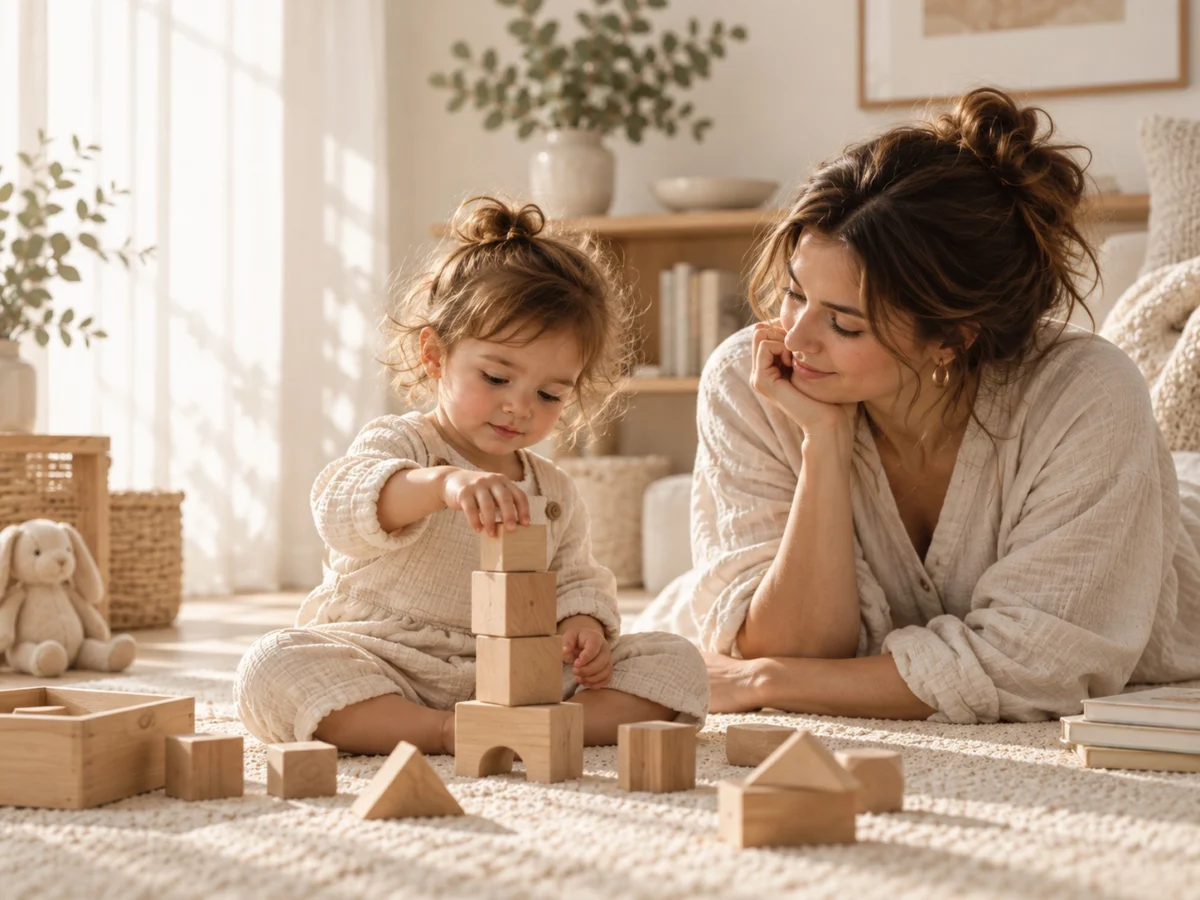
Many parents who search for independent play are not trying to create a child who disappears into a playroom for an hour. They want enough space to make dinner, answer a message, drink coffee while it is still warm, or simply stop being the director of every game.
Independent play is not a command to entertain yourself. It is the growing ability to start, shape, and stay with play that is led mainly by the child, even when a trusted adult remains nearby. Thinking of it as a capacity rather than a test makes it easier to build without pressure.
Start with a smaller definition of independence
A toddler playing for six focused minutes has not failed because another child reportedly plays alone for forty. The length changes with age, temperament, time of day, hunger, tiredness, the environment, and how much connection the child has needed that day.
Notice the beginnings of the skill: your child chooses something without asking you what to do, creates a small idea, stays with it after checking where you are, or returns to the play after a brief interruption. Those are meaningful steps.
You also do not have to leave the room. A child building on the floor while you fold laundry, read, or prepare food nearby can still be playing independently. For many young children, your calm presence is what makes exploration possible. Independence and proximity are not opposites.
Avoid announcing the goal too heavily. “You need to learn to play by yourself” can turn play into another developmental assignment. A simpler message is: “I’m going to do this here. You can play nearby.”
Make it easy to start without supplying the whole idea
A crowded room can paradoxically make play harder. When dozens of toys compete for attention, the child has to make many decisions before doing anything. A manageable set of blocks, figures, cars, books, pretend objects, or art materials may make the first move easier.
You do not need a perfect rotation system or minimalist shelves. Put some things away if the space feels visually overwhelming and make common materials easy to reach. The useful question is whether the child can see an option, access it, and begin without waiting for an adult to set up an activity.
Try offering less direction. Instead of “Let’s build a zoo and put all the animals here,” you might simply place the animals and blocks within reach. A little empty space at the beginning can feel uncomfortable to adults, but it is also where the child’s own idea has room to appear.
If your child repeatedly asks you to start, use a bridge rather than an abrupt refusal: “I’ll build one garage with you, then I’m going to finish dinner and you can keep going.” Over time, make the adult contribution smaller.
Do not interrupt the independence once it arrives
Adults often see good play and instinctively join it with questions: “What are you building?” “What color is that?” “Can you count them?” The intention is warm, but every question can pull the child out of the thread they were carrying.
Sometimes support looks like not entering. If your child is absorbed and safe, let the play stay theirs. You can comment later if they invite you in.
The same principle applies to boredom. “I’m bored” does not always require an immediate activity suggestion, craft, outing, or screen. You can acknowledge the blank moment: “You don’t know what you want to do yet.” Then leave some room.
Not every bored child will invent a brilliant game. They may complain, wander, look at books, or return to you. The point is that if every empty moment is filled from outside, there is little chance to practice generating the next idea from inside.
Build a rhythm that includes both connection and child-led space
Independent play often grows more easily when it appears at familiar times. Maybe after breakfast you clean the kitchen while your child plays nearby. Maybe after daycare you connect for a few minutes, then they have open play while you unpack bags. Repetition makes the separation in attention feel expected rather than sudden.
Some days your child will want much more of you. After a long separation, during a change, when tired, or simply because today is different, the same child may have less capacity for independent play. That does not erase the skill.
Shared play still matters. You do not need to reject every invitation in order to protect autonomy. In fact, predictable periods of genuine connection can make it easier for a child to tolerate periods when your attention is elsewhere.
Measure progress across weeks, not by whether today’s session reached a target number of minutes. A child who increasingly starts their own games, needs less setup, or can stay immersed while you remain nearby is developing the capacity even if the duration varies.
The goal is not a child who never asks you to play. It is a child who knows that playing with you is one wonderful option and that, little by little, they can also create small worlds of play that do not need an adult to keep them moving.