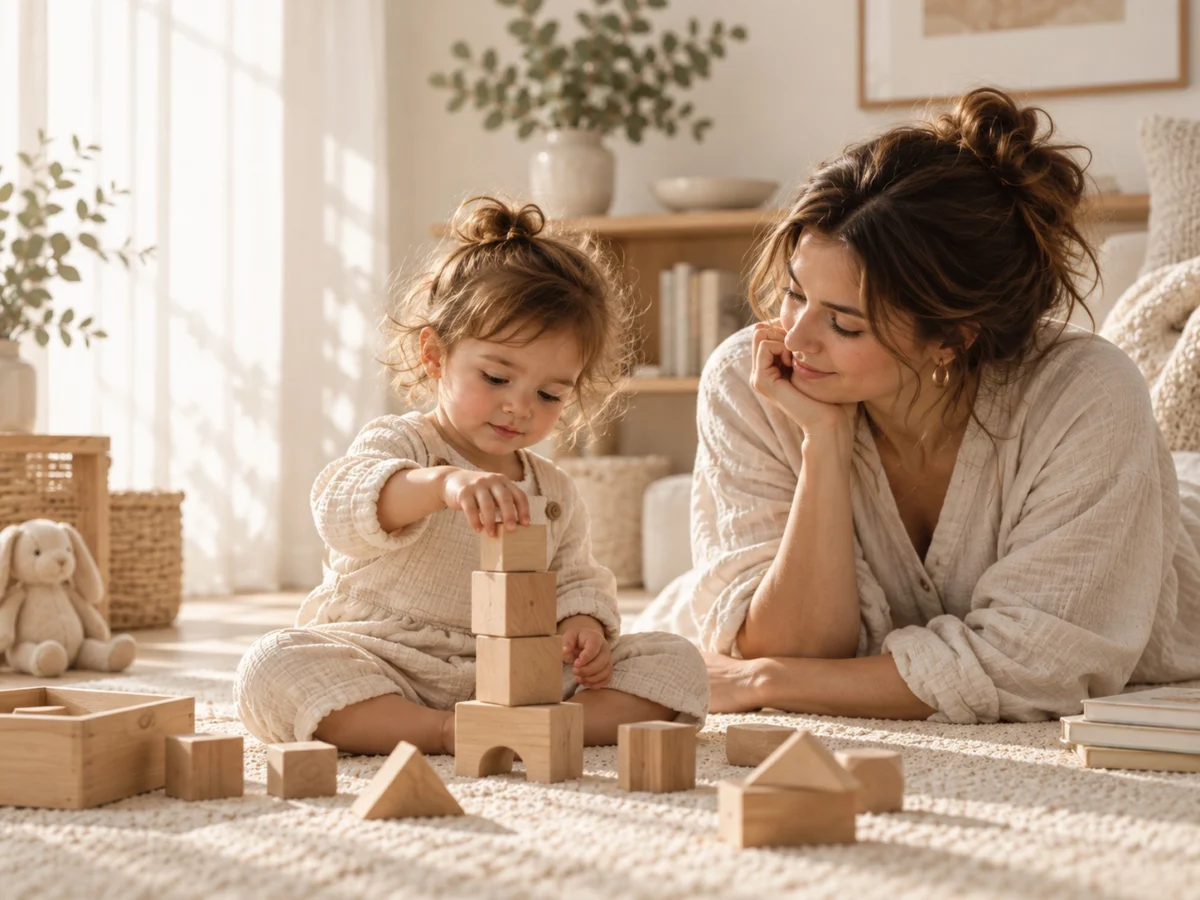
Parents can spend longer preparing a toddler activity than the toddler spends doing it. You print, tape, sort and arrange materials, only to watch your child abandon the setup after two minutes and play with the cardboard box. That is not evidence that you chose the wrong activity. It is often evidence that young children are interested in actions, materials and repetition more than in an adult’s planned result.
At-home play gets easier when you stop trying to produce a constant stream of novel entertainment. Toddlers often return to the same basic ideas: carrying, filling, dumping, pushing, stacking, peeling, pouring, hiding, building and knocking down. A useful activity gives those interests room without requiring you to direct every move.
Start with the action your toddler is already repeating
Before searching for another craft, watch what happens naturally. A child who fills a bag with random objects may be exploring transporting. One who removes every couch cushion may want to build and change the environment. A toddler who moves spoons between containers may happily repeat the same transfer for much longer than they would follow instructions for a finished project.
You can build from that observation with ordinary materials. Put a basket beside a few containers and large, safe household objects such as wooden spoons, washcloths, blocks or rolled socks. Leave enough room for your child to decide whether to sort them, carry them, hide them or invent something else. The lack of a correct outcome is part of what keeps the activity open.
Water works on the same principle. A shallow tub, two cups and a large spoon can become pouring and transferring without a sensory table or complicated theme. If indoor water makes you tense, move it to a bathtub, porch or sink. An activity that creates more stress for the adult than interest for the child is not automatically worth doing just because it looks educational.
Use materials that can become several different games
Cardboard boxes, painter’s tape, cushions, paper and easy-peel stickers earn their place because the child can change the purpose. One strip of tape can be a road, a boundary, a parking place or simply something satisfying to peel. A large box can become a bus, cave, bed, garage or drawing surface. Couch cushions can become a bridge, obstacle path or den—and knocking everything down may be the best part.
For a quieter period, a large sheet of paper with chunky crayons or stickers usually offers more ownership than a craft that has to look like an animal when finished. Your toddler can cluster, scribble, peel and rearrange. The final page does not have to prove that learning happened.
Keep the setup proportional to your energy. One or two colors may be better than an entire art cabinet. A towel under water play may make the difference between an activity you are willing to repeat and one you avoid. Good home play fits the household as well as the child.
Let real family work count as an activity
Many toddlers are most interested in whatever the adult is doing. Instead of always redirecting them toward a separate toy, give them a small way to participate. They can carry laundry to a basket, wipe a low surface, place spoons on the table, match socks, rinse something at the sink or move safe groceries from one bag to another.
They will not make the task faster. Efficiency is not the point. Real work is compelling because it has a visible purpose and because the toddler is participating in family life rather than being entertained beside it.
Movement also deserves to count. On some afternoons, stickers will fail because your child’s body wants to push, climb and run. Dance through two songs, move cushions, push a box of stuffed animals or make a simple path around the room. Matching the activity to the child’s current energy is often more effective than insisting on the activity that looked best when you planned the day.
Repeat what works and leave some empty space
If an activity lasts three minutes, resist the reflex to present the next one immediately. Your child may return to it, combine it with another game or wander until a new idea develops. When an adult fills every quiet gap with a new proposal, the adult can accidentally become responsible for keeping play interesting all day.
Connection matters, and toddlers still need help, conversation and shared play. But they do not need a cruise director. A small set of familiar, reusable materials can come out when you cook, take a call or simply need the room to settle. Rotate occasionally rather than constantly.
Adults are often impressed by novelty; toddlers are often strengthened by repetition. If the same box has been a boat for a week, it is still working. If pouring water was absorbing yesterday, there is no prize for replacing it today. Judge an at-home activity less by how original it looks and more by whether your child can take ownership of it without you managing every minute.