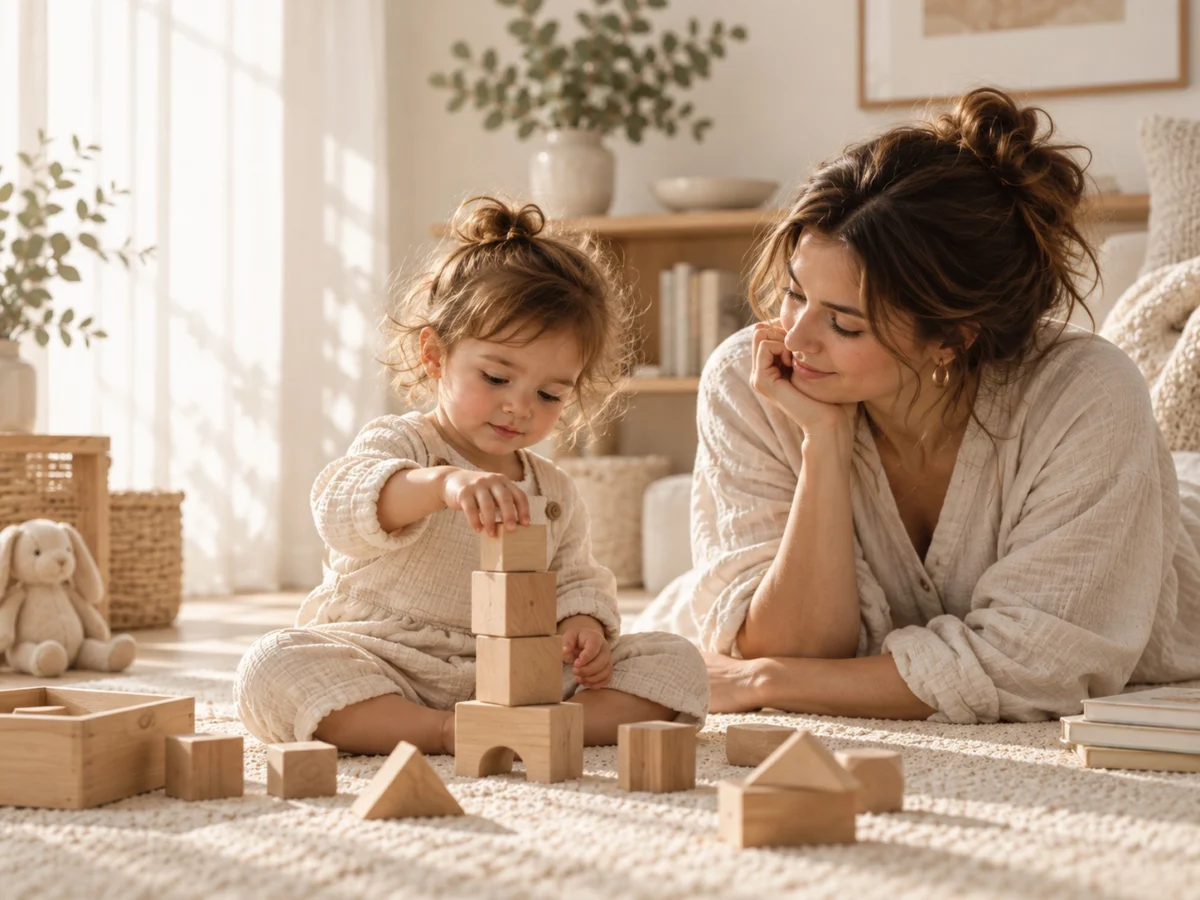
Some toys create a spectacular first afternoon and then slowly become scenery. Others look almost too simple on the shelf and keep returning to the floor for years. Price and branding do not explain the difference very well. Often the important question is how much of the play the object has already decided for the child.
A toy with one button, one sequence, and one obvious result can be fun. An open-ended material leaves more unfinished. Blocks can be a wall today, food tomorrow, a road next month, or simply objects to carry from one container to another. Fabric can become a cape, a bed, a river, or a roof. The child supplies more of the purpose.
Open-ended does not mean better in every situation. It means the object can keep changing jobs as the child’s interests and abilities change.
Open-ended describes the play, not a shopping category
There is no official badge a toy needs. The useful test is whether there are many reasonable ways to use it and whether play can continue after the child understands its basic function. Blocks, simple figures, dolls, vehicles, art materials, containers, cardboard, fabric, magnetic pieces, and ordinary household objects can all qualify.
A realistic object can still be open-ended. A truck is recognizably a truck, but it can transport stones, join a pretend rescue, become part of a construction site, or sit in a line because lining things up is what interests the child today. By contrast, a toy can look beautifully minimalist and still have only one meaningful action.
This matters because the term has become a marketing promise. Families can end up buying expensive coordinated sets in pursuit of supposedly simpler play. The irony is obvious: a philosophy about leaving room for imagination becomes another reason to accumulate things.
Before buying, look at what already gets reused in your home. A basket, masking tape, old scarves, animals, cars, blocks, paper, and a cardboard box may already form a rich open-ended collection. The goal is not to own the correct aesthetic. It is to have some materials whose purpose is not exhausted after one short sequence.
Why the same material can survive several developmental stages
A two-year-old and a five-year-old may use the same blocks in completely different ways. The younger child may carry them, stack two, knock them down, sort them, or fill a bucket. Later the same pieces may become houses, parking garages, elaborate worlds, or tools inside a story.
Adults sometimes miss this because we expect imaginative play to look like a finished scene. A toddler repeatedly putting every animal into a container and dumping them out may look less creative than building a zoo, but the child is still investigating space, sequence, movement, and control. Open-ended play does not need to produce something recognizable to be worthwhile.
Stepping in too quickly can narrow the possibilities. When an adult says, “Build a castle,” the material is still open, but the invitation has become specific. Sometimes children enjoy that collaboration. Other times they need enough quiet space to discover an idea we would not have suggested.
That is also why a toy that seems ignored at one age may become useful later. Rotation can help, but it does not need a calendar. Put away items that have become background, bring them back after a while, or change what sits beside them. Animals next to blocks may create different play than animals next to play dough. Novelty can come from a new combination rather than a new purchase.
Choose for your actual child and your actual home
Versatility is only one criterion. Interest matters more. A theoretically perfect material that your child never touches is not more valuable than a simple train set they use every day. Notice what kind of action they return to: building, transporting, drawing, caring for dolls, making small worlds, moving large objects, dressing up, sorting, or inventing stories.
Practical fit matters too. Fifty tiny pieces may support wonderful play and still be a poor fit for a home with a crawling baby. A large wooden set may last for years but be unrealistic in a small apartment. A material that requires an adult to set it up, supervise every second, and sort it into twelve categories afterward may not create much independent play in your family.
A useful buying question is not “Is this educational?” but “What will my child be able to do with this after the novelty wears off?” Then ask whether it combines with what you own, whether cleanup is manageable, and whether you can imagine using it in more than one season.
Closed-ended toys still belong in childhood. Puzzles, matching games, shape sorters, musical toys, and games with rules can offer concentration, mastery, humor, and pleasure. A healthy play environment does not need to choose a side. It can include both the satisfaction of completing something and the freedom of inventing what the something is.
Less adult direction can make simple materials more useful
Sometimes the most important change is not what you buy but what you stop doing. You do not have to demonstrate every possibility, correct unusual uses, or turn play into a lesson. If the use is safe and workable, the child can decide that the blocks are pancakes or that the cardboard tube is a microphone.
When play stalls, you can alter the environment rather than perform entertainment. Move a few materials to a low surface, reduce the number visible at once, add one familiar object from another category, or simply sit nearby without taking over. A child may need connection before playing independently, but connection does not require supplying the storyline.
The strongest reason open-ended toys often last is simple: they leave unfinished work for the child. As the child changes, the unfinished part changes too. That makes the same object capable of becoming interesting for reasons no package could have predicted.